Wondering where the floppy disk you remember came from? Floppy disk history runs from IBM’s 8-inch disk, with patents filed in 1972, to the 5.25-inch Minifloppy of 1976 and the 3.5-inch standard of 1982.
This guide belongs to the retro computing section of the site.
| Item | Value |
|---|---|
| IBM floppy patents filed (disk and drive) | 1972 |
| 8-inch drive introduced by Shugart Associates | 1975 |
| SA 400 Minifloppy (5.25-inch) capacity | 110KB |
| SA 400 OEM price | $390 for the drive, plus $45 for ten diskettes |
| 3.5-inch specification agreed (maximum capacity) | 1982 (up to 1.44MB) |
| Peak floppy drive production | 1990 (around 120 million units per year) |
The figures come from the Computer History Museum text on StorageNewsletter and a Technology Tap podcast episode. Dates and numbers in retro-tech histories can change as sources are revised, so check the source before you rely on them.
Why IBM needed a floppy disk
In the late 1960s, punch cards and tape reels were the usual way to move data around. According to a Technology Tap podcast episode, the floppy was born at IBM to replace those cumbersome media with something more practical and portable.
The same episode names Alan Shugart as project leader. The early prototype was the IBM 23FD, and the engineers nicknamed the first prototypes “Minnow”. It measured 8 inches across, held 80 kilobytes and was read-only, as the episode transcript describes it.
Early disks had a practical problem: dust and fingerprints damaged them. The fix was a fabric-lined sleeve that cleaned the disk surface during operation, according to the same podcast. Patents for both the disk and the drive were filed in 1972, and the first real-world use was the IBM 2835 storage controller.
The sources do not line up perfectly. The Computer History Museum text says Shugart joined Memorex in 1969 and founded Shugart Associates in 1973, so treat the exact timeline of who did what at IBM as approximate. You can read the museum text on StorageNewsletter next to the podcast and compare.
From IBM’s 8-inch disk to the Minifloppy
By 1973, IBM’s read-write floppy drive could store the equivalent of 3,000 punch cards on a single disk, with each disk costing between $5-8, according to the Technology Tap episode. The maximum capacity was just over 1 megabyte. That was a leap for portable data, even if it looks small today.
Shugart Associates, founded in 1973, set out to build a small business computer. The company left that project unfinished, but a key component survived as an 8-inch floppy disk drive introduced in 1975, as the Computer History Museum text explains.
The next step came from a customer. Wang Laboratories asked for a lower-cost drive, and in 1976 the company announced a 5.25-inch model, the SA 400 “Minifloppy”. The same text gives these launch details:
- Capacity: 110KB per disk.
- Drive price to OEM customers: $390.
- Media price: $45 for ten diskettes.
Software helped the smaller drive spread. Digital Research ported the CP/M operating system to the new disk size, which helped establish the SA 400 as a popular choice for small business and personal computers, per the museum text. The wider story of the machines these drives served is told in the history of personal computers.
How did the 3.5-inch disk win?
Users wanted a sturdier diskette package and a smaller enclosure. That demand produced competing formats ranging from 3.5 to 2 inches, according to the Computer History Museum text.
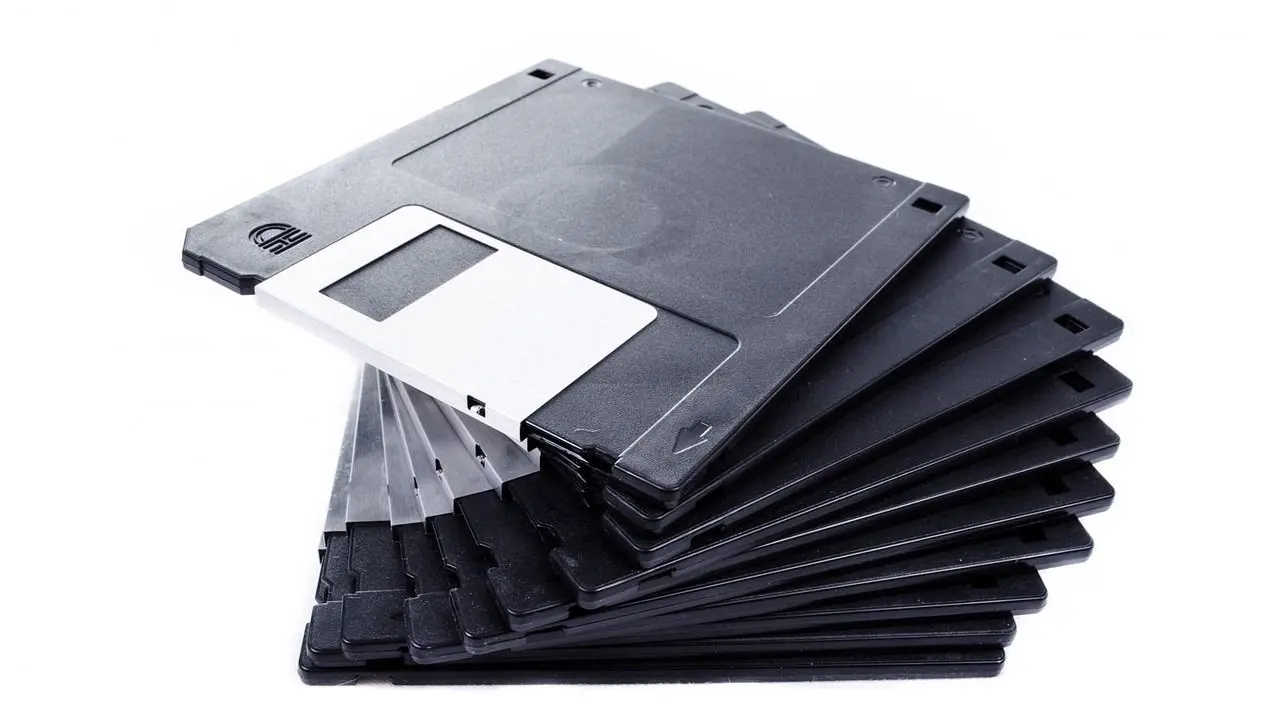
In 1982, the Microfloppy Industry Committee agreed on a 3.5-inch specification based on a Sony design. The same source says this set off an international scramble among vendors to serve the growing PC market. The disk now sat in a stiff outer case and held up to 1.44MB, yet the floppy name stayed.
Manufacturing scale mattered as much as the format. In the early 1980s, Shugart Associates, by then owned by Xerox, contracted with Matsushita for high-volume manufacturing. Matsushita received the right to sell to others and became the world’s largest floppy drive producer, as the museum text reports.
The same company’s engineers left another mark. In 1979 a team led by Larry Boucher, later the founder of Adaptec, developed the Shugart Associates System Interface (SASI). It later evolved into SCSI, the Small Computer System Interface, according to the same source.
Zip drives and the long decline
Not every successor kept the floppy’s modest capacity. In 1994, Iomega introduced the Zip drive, which stored 100MB on removable 3.5-inch “superfloppy” cartridges, as the Computer History Museum text notes.
The floppy business itself peaked in 1990 at around 120 million drives per year. After that it declined in favor of recordable compact disks, according to the same source. The source does not give a single end date for the format, so this article does not claim one.
What the floppy left behind
The Technology Tap episode calls the 8-inch floppy too unwieldy for home computing, yet it says the disk set the blueprint for later portable storage. The podcast is a popular retelling rather than a technical paper, so read that claim as the host’s view.
The sources also give capacity figures for three stages of the format, each stated in its own unit. Read them as separate data points from different sources rather than a precise like-for-like comparison, since the early prototype and the later disks were built for different machines.
- The IBM 23FD prototype held 80 kilobytes and was read-only, according to the podcast transcript.
- The SA 400 Minifloppy announced in 1976 stored 110KB per disk, according to the Computer History Museum text.
- The 3.5-inch disk in its stiff outer case held up to 1.44MB, as the same text states.
If you like to see how this hardware era shaped what people built on screen, the guide to early web design 1990s is a good next read. The disks, drives and committees above also give you a vocabulary for reading old product listings.
Frequently asked questions
When were the first floppy disk patents filed?
Show answer
According to the Technology Tap episode, patents for both the disk and the drive were filed in 1972. IBM’s read-write drive followed by 1973.
How much did an early 5.25-inch drive cost?
Show answer
The SA 400 Minifloppy sold to OEM customers for $390, plus $45 for ten diskettes, according to the Computer History Museum text. It stored 110KB.
How much could a 3.5-inch floppy hold?
Show answer
The 3.5-inch format, specified in 1982, held up to 1.44MB in its stiff outer case, as the same text states.
When did floppy drive production peak?
Show answer
Manufacturing peaked in 1990 at around 120 million units per year, then declined in favor of recordable compact disks.