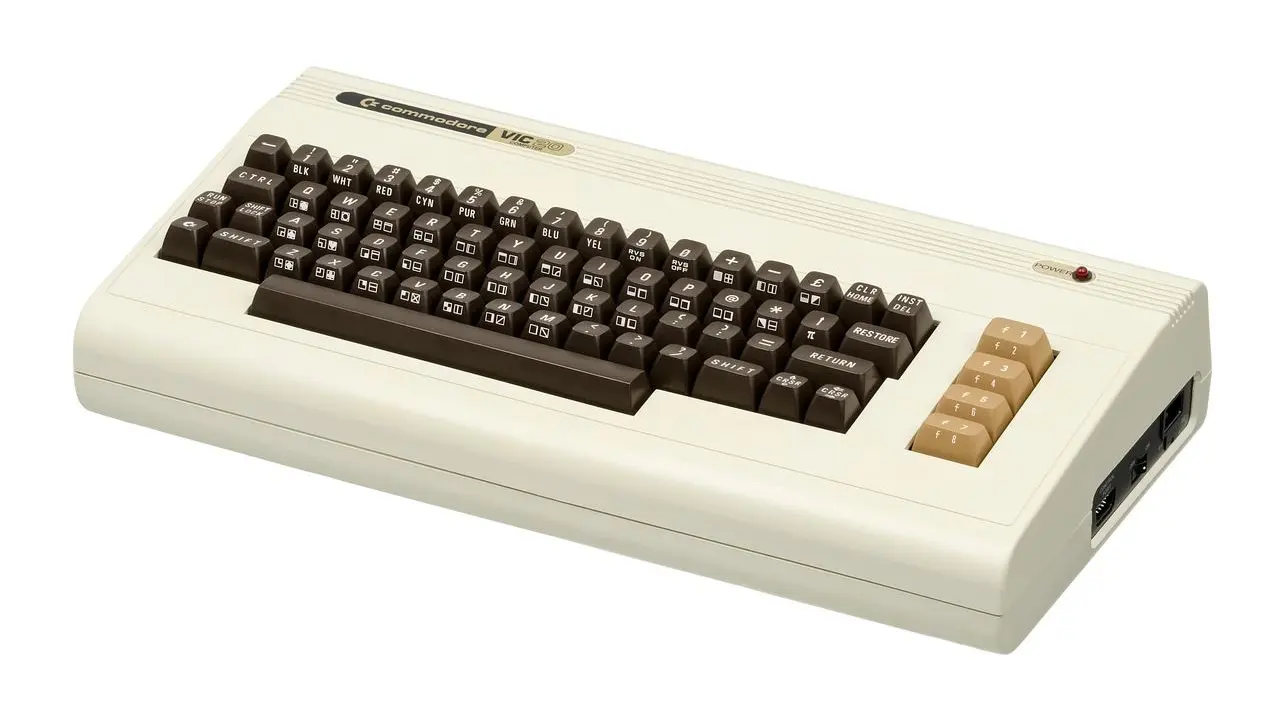
You may be curious how one home computer outsold its rivals. The short commodore 64 history: Commodore unveiled it in 1982 at a low price, built it on custom chips, and sold millions before going bankrupt in 1994.
This page is part of the wider topic of retro computing, where each classic machine gets its own short story.
| Item | Value |
|---|---|
| Public debut | CES, 1982 |
| Estimated launch price | $595 |
| Memory | 64KB of RAM |
| Units sold by 1994 | 10 to 17 million units |
| Sound chip voices | 3 voices (SID) |
| Commodore bankruptcy | 1994 |
These figures come from Adafruit’s Commodore 64 retro guide and Retro Isle’s Commodore 64 history. Sales and price figures can change as researchers revise them, so check the sources before you rely on them.
From typewriters to a chip factory
Commodore began as a very different business. According to Adafruit’s retro guide, the company started out making typewriters and adding machines, then moved on to electronic calculators and eventually computers.
The turning point came in 1976, when Commodore bought MOS Technology, the company that built the 6502 processor used in the Atari 2600, NES and Apple II. Adafruit names this as part of Commodore’s success, because the firm could manufacture its own chips in-house at MOS.
Hackaday’s April 20, 2022 article by Bil Herd calls the 6502 the heart of many home computers of its era, from Atari and Apple to the BBC Micro and Commodore. The same Hackaday piece says the chip sold initially for $25 and ultimately for less than a dollar.
The PET and VIC-20 had already been successful, and in 1981 Commodore started working on a new system with new chips. The Digital Antiquarian describes how it began: in January 1981 some MOS engineers found themselves without a whole lot to do.
They would have preferred a 16-bit replacement for the 6502, but Jack Tramiel was uninterested in funding such an expensive and complicated project. So the engineers settled on a more modest graphics and sound chip project that would dramatically exceed the VIC-20.
The chips that made the C64 special
According to Retro Isle, the new chips were completed by November 1981. Tramiel decided against using them in the faltering arcade game market and asked for a 64 kilobyte home computer for the Winter CES in January 1982, just 6 weeks away.
Adafruit adds that Tramiel wanted 64KB of RAM, which was expensive at the time. He knew prices were coming down and that it would be viable by the time the machine was ready.
Three things stood out once the machine was finished:
- Graphics: the VIC-II chip, designed by Al Charpentier, allowed up to eight onscreen sprites and palettes of up to 16 colors at resolutions of up to 320 X 200, as the Digital Antiquarian explains.
- Sound: the SID chip could play three different voices, and Retro Isle calls it without doubt the best sounding computer on the market at any price for years to come.
- Ease of use: like the PET and VIC-20 before it, the machine booted to a friendly screen with Commodore BASIC ready and waiting for instruction.
Sprites are predefined blocks of graphics that can be moved around by simply changing pointers, rather than having the processor redraw the object. Hackaday notes that the sprites could also tell the processor when they collided, which is useful for games.
The sound side came from Bob Yannes, who was just 24 years old and had been hired by MOS right out of university in 1978. Hackaday lists the SID’s envelope generators, oscillators and filters as components of the musical synthesizers of the day.
Why did the C64 cost so little?
The answer starts with those in-house chips. Retro Isle says the initial production cost target was $130 and the real figure came in at $135, against an opening price of $595. Within a few years, it estimates, falling component costs and economies of scale cut the cost of manufacture to less than $50.
Retail prices as high as $1000 had been proposed before the CES announcement for the base machine, with no floppy drive, cassette drive or monitor. Commodore quickly settled on the more reasonable $595 instead.
Several design choices kept costs down, and each came with a trade-off:
- The VIC-20 plastic chassis was reused. Reducing the size of the cartridge slot, changing the colour and adding a new logo was all that was required.
- Commodore BASIC 2.0 was kept even though a substantially improved PET BASIC 4.0 existed, because the upgrade would have needed more ROM, which cost more.
- The screen reports 38,911 bytes free rather than 64,000, because nearly half of the memory is used for internal functions such as BASIC.
Where it was sold mattered as much as the price. Adafruit says Commodore sold the C64 in regular stores rather than just in computer or electronics stores. Retro Isle names Sears, Toys ‘R’ Us and K-Mart among the chains that sold these machines like they were toasters.
Rival machines were priced close by. In its history of the C64, the Digital Antiquarian gives the TI-99/4A a list price of just $525. The same piece argues the C64’s final design exceeded or at least matched the aggregate capabilities of anything else on the market.
How many units did the Commodore 64 sell?
Adafruit’s guide says Commodore sold between 10 and 17 million units by 1994. That is a wide range, and it is not the only estimate in circulation.
As of Hackaday’s April 20, 2022 article, the Guinness record listing gave 27 million units sold for the most popular home computer ever. The same article adds that some analysis of serial numbers suggests fewer units were sold in actuality, though it says there is little doubt the C64 far outsold the competition.
Software followed the hardware. Adafruit says developers wrote tens of thousands of titles for the system, and games were especially popular because the VIC-II and SID chips were far more capable than the video and sound in most other computers.
Retro Isle also argues the C64 was the first computer that millions of today’s programmers, designers, engineers and enthusiasts had ever used. For the wider background of that period, the history of personal computers shows where this machine sits among its peers.
Decline and legacy
By the early 1990s, Adafruit explains, PCs were getting more affordable and more capable, and the market for systems like the C64 was dying out. Commodore released the Amiga while battling with Atari, then owned by former CEO Jack Tramiel, over rights to produce such a computer.
It was not enough to save the company from the PC, and Commodore declared bankruptcy in 1994. You can follow the machine Commodore bet on next in this amiga computer history.
The C64 itself did not disappear. As of Adafruit’s March 2024 edit, people were still writing new software, building new add-ons and even building modern versions of the 64 with HDMI and Ethernet.
Frequently asked questions
When was the Commodore 64 released?
Show answer
Adafruit says the C64 debuted at CES in 1982 and started shipping eight months later. Retro Isle puts the estimated retail price at that show at $595.
Who designed the Commodore 64’s chips?
Show answer
The Digital Antiquarian credits Al Charpentier with the VIC-II graphics chip and Bob Yannes with the Sound Interface Device, or SID. Both worked at MOS Technologies, Commodore’s chipmaking subsidiary.
How much memory did the Commodore 64 have?
Show answer
It had 64KB of RAM, according to Adafruit. Retro Isle explains that the screen showed 38,911 bytes free because nearly half of the memory is used for internal functions like Commodore BASIC 2.0.
Is the Commodore 64 still used today?
Show answer
As of Adafruit’s March 2024 edit, the C64 still has a huge enthusiast following. The guide says it is also well supported by emulators.